 BP Notebook
Blood pressure chart for adults
What the numbers on your monitor mean, using the categories in the 2025 American Heart Association and American College of Cardiology guideline, and in the 2024 European Society of Cardiology guideline.
Blood pressure categories (AHA/ACC 2025)
A reading has two numbers, for example 128/82 mmHg. The top number (systolic) is the pressure when your heart beats. The bottom number (diastolic) is the pressure between beats.
| Category | Top number (systolic) | Bottom number (diastolic) | |
|---|---|---|---|
| Normal | Less than 120 | and | Less than 80 |
| Elevated | 120 to 129 | and | Less than 80 |
| Stage 1 hypertension | 130 to 139 | or | 80 to 89 |
| Stage 2 hypertension | 140 or higher | or | 90 or higher |
If the two numbers fall in different rows, the higher category applies. For example:
- 125/78 is elevated: the top number is 120 to 129 and the bottom number is under 80.
- 125/80 is stage 1: the bottom number, 80, is in the stage 1 range.
- 118/92 is stage 2: the top number is normal, but the bottom number is 90 or higher.
"Hypertension" is the medical word for high blood pressure. Only a doctor or other health care professional can diagnose it, usually from several readings over time rather than a single one.
Above 180/120? The American Heart Association advises waiting at least 1 minute and taking your blood pressure again. If it stays this high and you have chest pain, shortness of breath, back pain, numbness, weakness, vision changes or difficulty speaking, call your local emergency number now. Without these symptoms, contact your health care professional.
European categories (ESC 2024)
In Europe and many other countries, doctors may use the 2024 European Society of Cardiology guideline. Its categories for readings taken in the clinic are:
| Category | Top number (systolic) | Bottom number (diastolic) | |
|---|---|---|---|
| Non-elevated | Less than 120 | and | Less than 70 |
| Elevated | 120 to 139 | or | 70 to 89 |
| Hypertension | 140 or higher | or | 90 or higher |
The ESC guideline also gives separate thresholds for readings taken at home and for 24-hour monitoring, which are lower than the clinic thresholds. Ask your doctor which numbers apply to you.
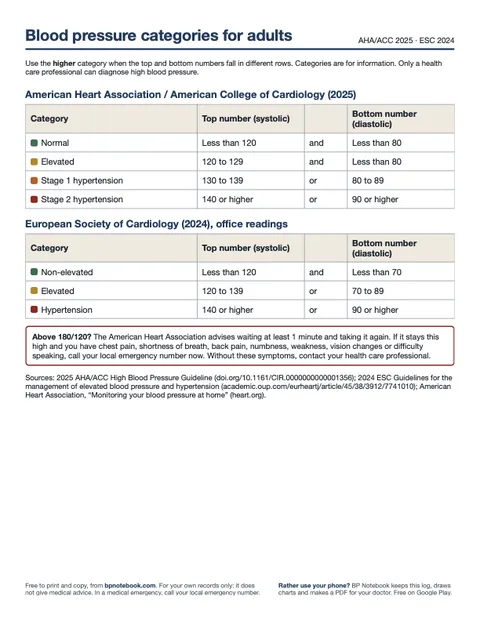
Printable blood pressure chart
Both tables on one page, to keep next to your monitor or on the fridge.
Blood pressure chart by age
Many charts online list a different "normal" for each age. The adult categories in the AHA/ACC and ESC guidelines do not work that way: the same table applies to every adult aged 18 and over, whatever their age.
Blood pressure does tend to rise with age, so average readings are higher in older age groups. But an average is not a target. Your doctor may set a personal goal that takes your age, health and medicines into account, so ask them what numbers you should aim for.
Children and teenagers are different: their blood pressure is compared with charts for their age, sex and height, and only a health care professional should interpret them.
Is the chart different for women and men?
No. The adult categories are the same for women and men. Pregnancy is an exception: blood pressure in pregnancy has its own guidance, so follow your maternity team's advice.
What about low blood pressure?
The category tables don't have a "low" row. Some people naturally have low readings and feel fine. If your readings are low and you feel dizzy, faint or unwell, talk to your health care professional; the American Heart Association notes that a doctor can evaluate low numbers.
Keep track over time
One reading is a snapshot. A record over days and weeks shows the pattern, which is what your doctor needs. Use a free printable blood pressure log, work out your average blood pressure, or let the BP Notebook app keep the log, show each reading's category and make a PDF for your appointment.
Sources
- Jones DW, et al. 2025 AHA/ACC High Blood Pressure Guideline (Table 4). Circulation, 2025.
- McEvoy JW, et al. 2024 ESC Guidelines for the management of elevated blood pressure and hypertension. European Heart Journal, 2024; 45(38): 3912–4018.
- American Heart Association. Monitoring your blood pressure at home. Last reviewed August 14, 2025.
Important
This page is general information, not medical advice. BP Notebook is not a medical device and does not diagnose, treat, cure, or prevent any medical condition. Talk to your doctor before making medical decisions.
If you have a medical emergency, call your local emergency number now.